

【Food Antioxidants Series 6】 A Key Player in Lipid Preservation | Propyl Gallate (PG)
Sep. 21, 2026
In modern food manufacturing, Propyl Gallate (PG) is a widely used synthetic antioxidant valued for its distinctive antioxidant properties and practical application benefits. It plays an important role in protecting lipid-rich foods against oxidative rancidity and is commonly used to preserve fried foods, fats and oils, canned foods, and other products. PG is recognized as one of the classic oil-soluble antioxidants used in the food industry.
1. Propyl Gallate (PG)
Propyl Gallate (PG), also known as propyl 3,4,5-trihydroxybenzoate, is a synthetic phenolic antioxidant.
Industrial production of PG primarily uses gallic acid and n-propanol as raw materials. These materials undergo an esterification reaction catalyzed by concentrated sulfuric acid or p-toluenesulfonic acid, followed by purification processes such as neutralization, extraction, crystallization, and recrystallization [5]. The final product must achieve a purity of at least 98.5% to meet the quality specifications for food additives.
The PG molecule contains three phenolic hydroxyl groups, which serve as the principal active sites responsible for its antioxidant activity [8]. Its limited solubility in both water and oil allows it to be used in a variety of food formulations and processing applications.
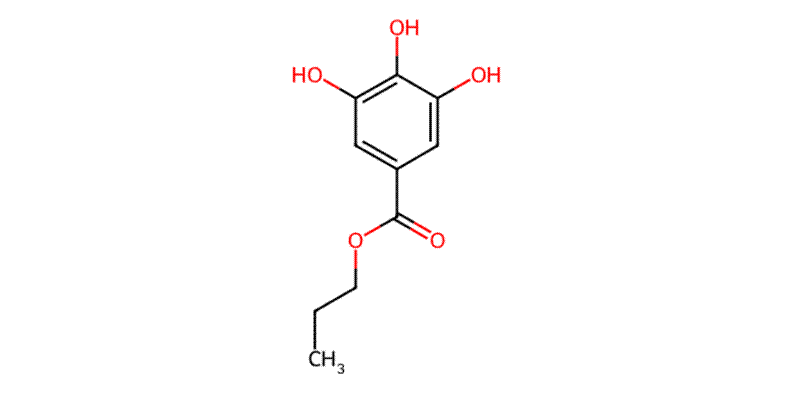
Image Source: ChemSpider
2. Basic Properties
Image Source: Baidu Encyclopedia (Baidu Baike)
2.1 Physical Properties
Propyl Gallate is a white to light brown crystalline powder that is odorless or has a slightly bitter taste. It has a melting point of 146–150°C and is readily soluble in organic solvents such as ethanol, propylene glycol, and ether, but only slightly soluble in water and fats. Its solubility in water increases slightly with temperature. When used in fats and oils, thorough mixing or a small amount of an appropriate solubilizing agent may be required to achieve uniform dispersion [11]. These properties make PG suitable for processing a variety of lipid-rich foods, including fats and oils, bakery products, and meat products.
2.2 Antioxidant Mechanism
As a phenolic antioxidant, PG donates hydrogen atoms to react with free radicals generated during lipid oxidation, forming stable phenoxy radicals and thereby terminating the free-radical chain reaction [7]. This mechanism reduces the formation of oxidative products such as aldehydes, ketones, and peroxides, helps prevent rancid odors and off-flavors, and preserves the original flavor and nutritional value of food.
PG can also effectively scavenge certain 1,2-dicarbonyl compounds in food, further contributing to safety during food processing.
2.3 Key Advantages
PG provides strong and targeted antioxidant protection for fats and oils. It is particularly suitable for preserving vegetable oils [6], animal fats [2], and fried foods. When used in combination with certain other antioxidants—subject to applicable national standards and regulatory requirements—it can deliver enhanced preservation performance.
PG also demonstrates good stability during low- and medium-temperature processing and generally has no significant adverse effects on the color or taste of food. Among commonly used synthetic antioxidants, antioxidant effectiveness is generally ranked as follows:
TBHQ > PG > BHT > BHA
PG is therefore considered a highly effective antioxidant, second only to TBHQ in this comparison [4].
2.4 Stability
PG exhibits good stability when stored at room temperature under dry conditions and protected from light. However, contact with metal ions such as iron and copper may cause discoloration [9], potentially affecting the appearance of the finished product. Its antioxidant activity decreases under alkaline conditions, where it is also more susceptible to decomposition.
2.5 Additional Properties
In addition to its primary antioxidant function, PG can scavenge certain intermediate oxidation products in food [5]. This helps reduce potential safety risks associated with lipid oxidation and indirectly contributes to the overall safety and quality of food products.
3. Broad Recognition in China and International Markets
-
China: PG is included in GB 2760-2024, National Food Safety Standard—Standard for the Use of Food Additives, which specifies its permitted applications and maximum use levels. It is legally approved as a food antioxidant in China.
-
European Union: PG is authorized as food additive E310 for use in fats, oils, and lipid-rich foods within prescribed limits. In 2024, the European Union updated the specifications for PG, including stricter limits on toxic elements, further strengthening regulatory requirements for its production and application.
-
United States: PG is classified by the U.S. Food and Drug Administration (FDA) as Generally Recognized as Safe (GRAS). It may be added to fats, oils, and applicable food products within specified limits, subject to relevant U.S. food safety requirements.
-
Codex Alimentarius: The Codex Alimentarius Commission (CAC) has established permitted applications and maximum use levels for PG. The Joint FAO/WHO Expert Committee on Food Additives (JECFA) has also established a strict Acceptable Daily Intake (ADI). PG is legally recognized for use in the food industry in many countries worldwide [3].
4. Safety
The safety of PG has been systematically evaluated on multiple occasions by leading food safety authorities worldwide. When used within the limits prescribed by applicable standards, PG has not demonstrated carcinogenic, teratogenic, or mutagenic effects [1]. It is a food antioxidant with a well-established safety record supported by many years of practical use in the food industry.
Toxicological data: JECFA has established an Acceptable Daily Intake (ADI) of 0.2 mg/kg body weight for PG [3]. The European Food Safety Authority (EFSA) has also adopted this value as the safe daily intake level for lifelong human exposure.
5. Applications and Maximum Use Level
Under the requirements of GB 2760-2024, the maximum permitted use level of PG, calculated based on the fat or oil content of the product, is 0.1 g/kg. PG is subject to strict use-level controls among synthetic antioxidants. Its applications cover a variety of oxidation-sensitive, lipid-rich foods, with the principal categories including:
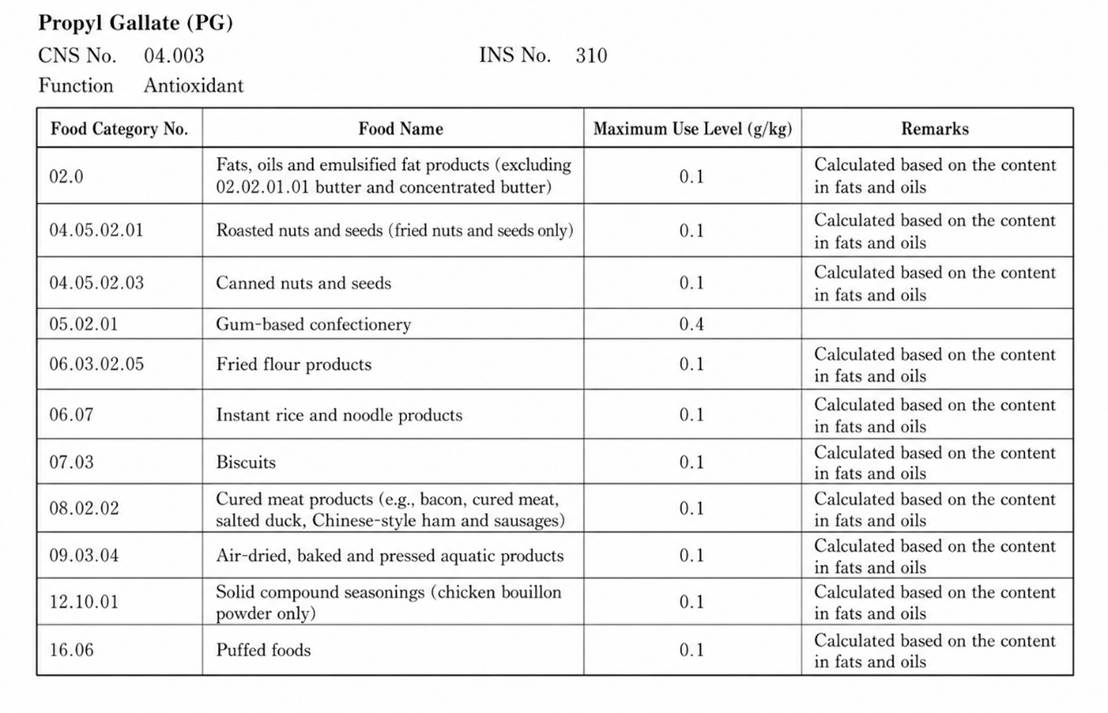
Note: When PG is used in combination with other synthetic antioxidants, the sum of the ratios of each antioxidant’s actual use level to its respective maximum permitted level must not exceed 1. All antioxidant combinations must strictly comply with the compound-use requirements specified in applicable national standards.
6. Precautions: Proper Use for Optimum Performance
-
PG should first be dissolved in ethanol or edible oil and then thoroughly mixed with the food ingredients to ensure uniform dispersion.
-
The amount of PG used must be strictly controlled within 0.1 g/kg, calculated based on the fat or oil content of the product. The maximum permitted level must not be exceeded.
-
Contact with containers or equipment made of iron, copper, or other reactive metals should be avoided. Metal chelating agents may be used during processing where permitted to help prevent discoloration.
-
PG is not recommended for use in alkaline food systems, as alkaline conditions may reduce its antioxidant activity.
-
PG should not be used in combination with TBHQ, as interactions between the two may adversely affect their antioxidant performance [4].
-
PG should be stored in a cool, dry place protected from light. Exposure to moisture and unsuitable storage conditions may cause degradation and reduce its antioxidant activity.
PG is a classic synthetic antioxidant recognized for its effectiveness, regulatory compliance, and established safety in the food industry. With its reliable antioxidant performance and broad application compatibility, it is an important preservation option for lipid-rich foods. When used in strict accordance with applicable conditions and limits, PG can effectively extend product shelf life and protect fats and oils against oxidative rancidity while maintaining food safety. It therefore serves as an important safeguard for the quality of lipid-containing foods in modern food manufacturing.
References
[1]EsazadehK ,Ezzati Nazhad DolatabadiJ ,AndishmandH , et al. Cytotoxic and genotoxic effects of tert‐butylhydroquinone, butylated hydroxyanisole and propyl gallate as synthetic food antioxidants[J].Food Science & Nutrition,2024,12(10):7004-7016.DOI:10.1002/FSN3.4373.
[2]张慧慧,高盼,陈哲,等. 没食子酸丙酯对猪油的抗氧化效果研究[J].食品安全质量检测学报,2023,14(23):43-50.DOI:10.19812/j.cnki.jfsq11-5956/ts.2023.23.005.
[3]Fatemeh J ,Mirza A A ,Parvin D , et al. Pharmacokinetic and toxicological overview of propyl gallate food additive.[J].Food chemistry,2023,423135219-135219.DOI:10.1016/J.FOODCHEM.2022.135219.
[4]肖菁,吴卫国,彭思敏. 食用油抗氧化剂及其安全性研究进展[J].粮食与油脂,2021,34(09):10-13+17.
[5]郭晓丹,宋京九,王东,等. 没食子酸及其衍生物的生理活性及研究现状[J].化学世界,2020,61(09):585-593.DOI:10.19500/j.cnki.0367-6358.20190410.
[6]吴永会,李法社,王霜,等. 没食子酸酯类抗氧化剂对不同植物油氧化稳定性能影响的研究[J].中国粮油学报,2019,34(05):56-61.
[7]裴玲. 没食子酸丙酯抗氧化活性及机理的理论研究[J].唐山师范学院学报,2016,38(05):31-34.
[8]李敢. 没食子酸丙酯的合成研究进展[J].现代盐化工,2016,(01):25-26.DOI:10.19465/j.cnki.2095-9710.2016.01.010.
[9]E M M ,Cristina I ,Raúl J A . Antioxidant activity of propyl gallate in aqueous and lipid media: a theoretical study.[J].Physical chemistry chemical physics : PCCP,2013,15(31):13137-46.DOI:10.1039/c3cp51644j.
[10]Jorge G ,Manuela E G ,Fernanda B . Studies on the Food Additive Propyl Gallate: Synthesis, Structural Characterization, and Evaluation of the Antioxidant Activity[J].J. Chem. Educ.,2011,89(1):130-133.DOI:10.1021/ed900025s.
[11]张霞,李杰,陈丹云. 没食子酸丙酯及其衍生物的合成研究进展[J].河北化工,2004,(05):18-19.
Neueste Blogs
-
Sep. 21, 2026
【Food Antioxidants Series 6】 A Key Player in Lipid Preservation | Propyl Gallate (PG)
-
Sep. 21, 2026
[Exhibition Review] L&P Foods Showcases Diverse Ingredient Solutions at Fi Asia Indonesia 2026
-
Sep. 18, 2026
【Food Antioxidants Series 5】 A New Force in Natural Antioxidants | Marigold Flavonoids
-
Sep. 18, 2026
-
Sep. 15, 2026
How TBHQ Extends Shelf Life in Oils and Snacks: Mechanism and Usage Tips